Watch one ordinary meal before changing your equipment. Note each time you cross the room, search a drawer or wash a utensil you need again. The interruption may look like a missing gadget when the underlying problem is placement. Moving the colander nearer the sink, clearing a preparation area or putting a mixing bowl within reach can remove more friction than another appliance.
Choose one repeated inconvenience rather than redesigning the kitchen at once. If measuring ingredients is the slow part, examine that sequence. If food repeatedly waits while you find a lid, sort the lids first. A useful change should be easy to explain in a sentence: “This keeps the timer audible while I prepare something else.”
When measuring creates extra washing
A digital kitchen scale can let you weigh ingredients directly into a bowl, resetting the displayed weight between additions. That may reduce measuring vessels, particularly for recipes written by mass. It does not make every recipe convertible without care: a volume of flour and the same volume of oil do not have the same mass.
Check capacity, stated resolution and platform size separately. A display showing small increments does not, by itself, prove equivalent accuracy. Put your usual bowl on the platform and consider whether it hides the screen. Check that you can operate the reset control without pushing the bowl sideways, and read the auto-off behavior before choosing a model for slow preparation.
The no-purchase alternative is often simpler preparation: set out your existing measures, group the ingredients and use an appropriately sized bowl. A scale earns its place when it fits recipes you actually cook, not recipes you imagine starting someday.
When attention keeps getting divided
A dedicated timer helps when a phone is occupied, out of earshot or too distracting to keep beside food preparation. Large controls, a readable display and an alarm you can hear from your normal working position matter more than a long feature list. If two dishes regularly overlap, clearly distinguishable timers may be more useful than one complicated screen.
A timer reports elapsed time; it does not establish that food is safely cooked. A suitable food thermometer measures temperature at the probe location. Follow food-specific guidance from a relevant authority, such as the USDA Food Safety and Inspection Service or the UK Food Standards Agency, rather than treating appearance or a preset timer as proof of safety.
Check the thermometer’s operating range, cleaning instructions and whether it is designed to remain in an oven. An instant-read probe and a leave-in probe are not interchangeable merely because both display numbers. Keep the manual accessible and avoid using a damaged probe.
When a small prep tool is enough
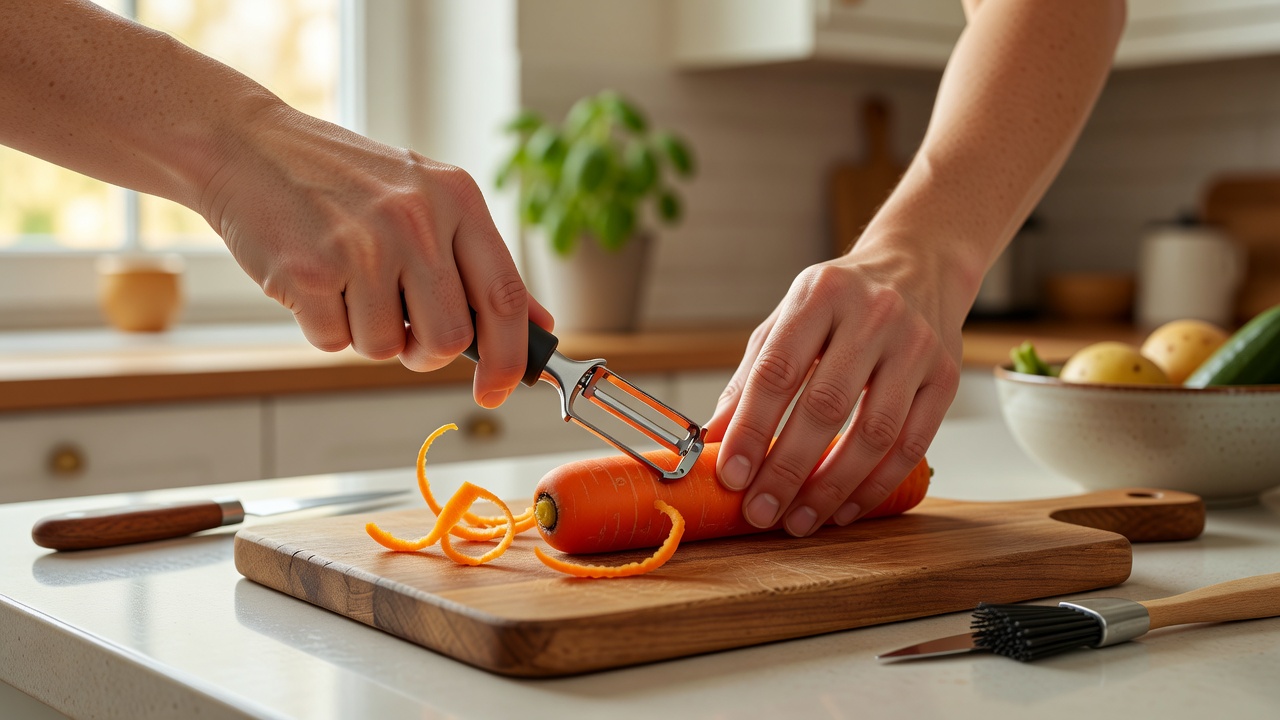
A comfortable peeler, a stable grater or an easy-to-open jar aid can solve a narrow problem without taking over the countertop. Look at the complete handling sequence. Can you hold it securely with wet hands? Is there a safe place for fingers? Can you remove trapped food without reaching across a blade?
Tools with concealed cutting surfaces or several inserts deserve an honest cleaning check. A device that saves a little preparation but adds fiddly disassembly may lose overall. Follow its instructions, use any supplied guard and do not assume dishwasher suitability from a metal-looking finish.
| Recurring problem | Possible tool | Check first |
|---|---|---|
| Too many measuring vessels | Digital scale | Bowl clearance and reset control |
| Missed cooking intervals | Dedicated timer | Audibility and straightforward controls |
| Uncertain food temperature | Food thermometer | Intended use and cleaning method |
| Awkward repetitive peeling | Comfortable peeler | Grip, blade protection and storage |
Give cleanup the final vote
Before buying, decide where the item dries and where it lives. Check whether seals, batteries or blades can be replaced, and whether spare parts are actually available for the model. Store cutting tools safely rather than loose among frequently handled utensils. If access needs influence your choice, assess grip, force and readability against your own routine rather than relying on a vague “ergonomic” label.
Then revisit the original inconvenience. If a rearranged drawer solves it, stop there. If not, select the smallest dependable tool that removes that step without creating a new maintenance obligation.