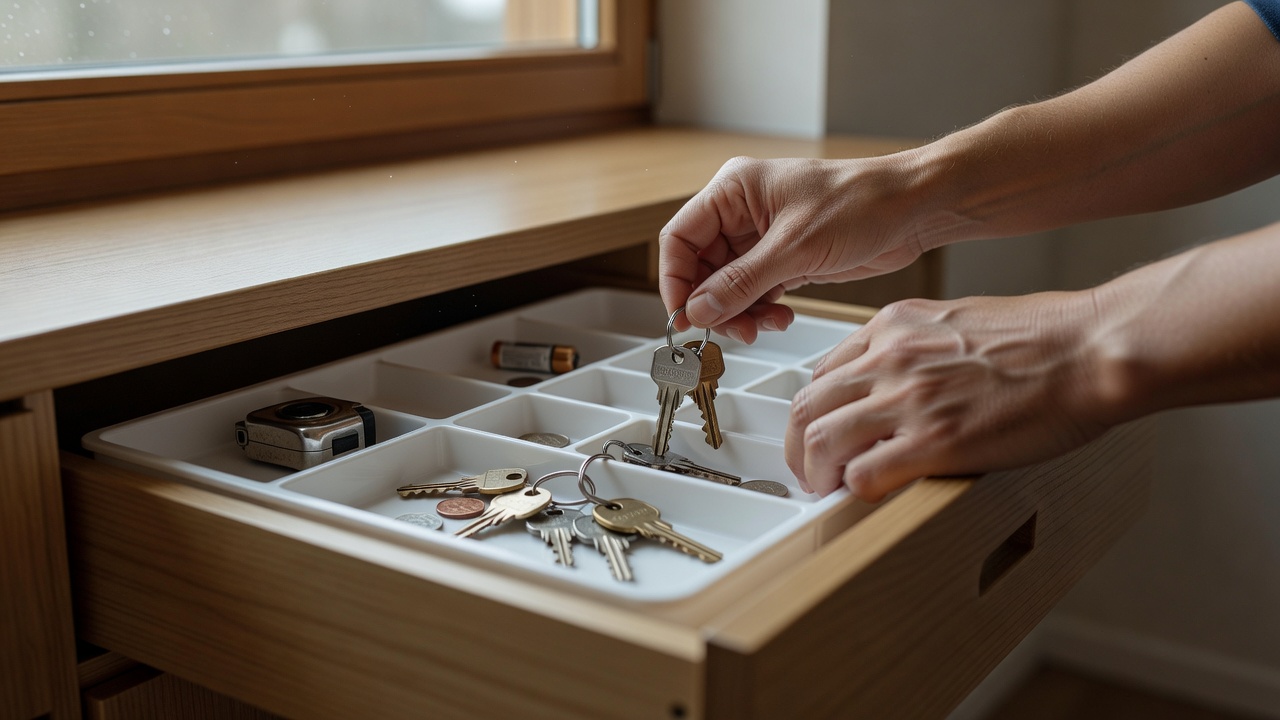
The recurring search for keys often begins much earlier than the moment you need them. You come through the door with several things in your hands, find no obvious landing place and put everything on the nearest clear surface. The next morning, the search looks like a memory problem. More often, the return journey was simply too difficult.
Start by watching where items naturally accumulate. A useful storage point usually sits near that location, not wherever a tidy photograph suggests it should be. An existing dish, shallow box or spare hook may be enough to test the idea. Avoid placing keys where they are visible or reachable from outside, including through a nearby opening.
Make the return easier than the detour
Give frequently used objects accessible places that do not require moving something else first. If putting a charger away means opening a cupboard, lifting a box and untangling several leads, it will probably stay on the counter. A shallow divider near the charging point may work better than a larger storage solution farther away.
Measure the usable space rather than the outside of the furniture. Drawer runners, hinges and rounded corners can reduce capacity. Leave room for fingers to lift objects out. A tightly fitted arrangement can look efficient while making every retrieval awkward.
Test the layout using scrap cardboard or containers you already have. Only then consider adjustable dividers or a purpose-made tray. Avoid storing damaged batteries, loose sharp objects or heavy items in places that invite careless handling.
Label the decision, not every object
A label is useful when several people need the same information or a container hides its contents. Use ordinary words that a visitor would understand: “spare charging leads” is clearer than a personal category that only makes sense to its creator. Broad, stable groups usually need less upkeep than elaborate subcategories.
A label maker can produce readable, replaceable labels, but paper and tape may be sufficient. Check the ongoing cost and availability of compatible tape before buying a printer. Test adhesive on a discreet area and follow surface-care instructions, particularly on finished wood, painted furniture and delicate plastics.
Do not label chemicals into anonymous containers or cover safety instructions. Keep hazardous household products in their original packaging and store them according to the manufacturer’s guidance. An orderly appearance is not a reason to remove information needed for safe use.
Use trackers as a backup, not a filing system
A Bluetooth item tracker can help locate a misplaced bag or key ring, but its abilities depend on the specific product, phone and surrounding network. Some devices mainly help at short range; others can report a location through a compatible finding network. Neither description guarantees continuous tracking or successful recovery.
Check support for your phone and operating-system version, battery replacement, attachment method and any account requirement. Apple Find My and Google Find Hub are examples of distinct finding ecosystems; compatibility with one does not automatically mean compatibility with the other. Read current manufacturer documentation rather than relying on a retailer’s shortened title.
Trackers should not be used to monitor someone without their informed consent. Review unwanted-tracking protections and location permissions. Keep devices and loose batteries away from children; button and coin batteries can cause serious harm if swallowed. Seek urgent medical help if ingestion is suspected.
| Problem | First attempt | Possible addition |
|---|---|---|
| Keys left on random surfaces | One secure landing place | Tray or suitable hook |
| Drawer contents mix together | Remove duplicates and group items | Adjustable dividers |
| Shared supplies disappear | Agree a common home | Simple readable label |
| Bag repeatedly misplaced | Consistent return habit | Compatible item tracker |
Keep the system maintainable
Leave some space unallocated. A drawer filled to its exact capacity becomes difficult to use as soon as one item changes. Put infrequent supplies elsewhere instead of forcing every object into the most convenient storage area.
Review any arrangement after normal use. Notice which items are still left out and ask whether the storage is too distant, too full or too hard to open. Change the return step before blaming the person. The most useful organizing tool is the one that makes a sensible habit easier to repeat.